
This week, that extends to contributing to our blog library! One of our key staff members, Kathy Dell, regularly interacts with our Clients and Crews and today she offers this insightful interview with one of our pilots.
Safety, Professionalism, and Excellence: Insights from an EASA TRI/TRE Training Pilot
As someone who works at Avionco Canada, I’ve had the unique privilege of seeing firsthand how the private aviation industry operates at the highest levels. Our company doesn’t just provide world-class private jet pilots to operators—we also offer a comprehensive suite of training services to manufacturers, ensuring that pilots meet the stringent standards required for aircraft like the Challenger 350/3500.
In this article, I’ll take you through some key aspects of becoming a TRI/TRE, explore various components of the Challenger 350/3500 takeoff and landing training program, and highlight how our company is helping manufacturers and operators meet industry standards.
The Role of an EASA TRI/TRE Pilot
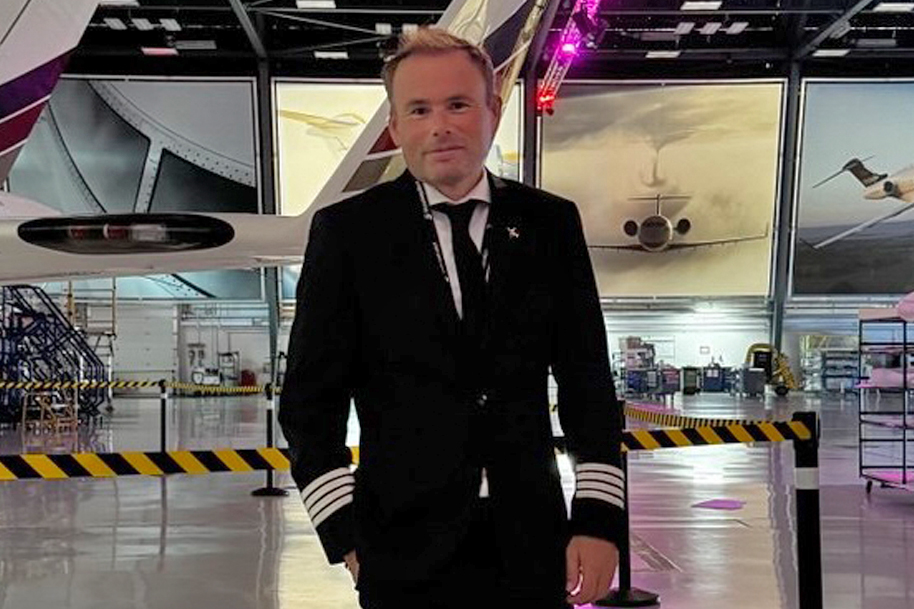
Recently, I had the opportunity to sit down with one of our EASA-certified Type Rating Instructors and Examiners (TRI/TRE), Martin Strunz, whose role in training pilots on this cutting-edge aircraft is vital to both the safety and efficiency of private jet operations. As we discussed the intricacies of his job, I was reminded of just how crucial specialized training is for maintaining the level of excellence that private aviation demands. Whether it’s mastering takeoffs and landings or navigating complex avionics systems, the role of a TRI/TRE is one that requires not only technical expertise but a deep commitment to safety and professionalism.
The Path to Becoming a TRI/TRE Pilot
Let’s start with how Martin became an EASA-certified TRI/TRE pilot. To pursue a TRI/TRE rating, a pilot must first choose an approved training organisation (ATO). In Martin’s case, he selected an EASA-approved ATO to begin his training. These organizations are authorized by EASA to provide the necessary training and certification courses, which include both theoretical and practical elements, along with assessments to ensure a pilot’s knowledge and skills are up to their standard.
Before applying to the ATO, Martin had to meet several prerequisites. These included a minimum number of flight hours, a valid EASA ATPL (Airline Transport Pilot License), significant flight experience (typically over 1,500 hours as pilot-in-command), previous experience on the aircraft type for which they wish to instruct and/or examine, and successful completion of the training modules that cover both the theoretical and practical aspects of conducting training and assessments.
Once Martin completed the required TRI/TRE training, he applied to the national aviation authority (NAA), which verified that all requirements had been met before issuing his EASA TRI/TRE rating. This application process also involved submitting flight logs and other documentation, as well as potentially passing an oral or practical exam to demonstrate his teaching and examination abilities.
The Importance of Touch-and-Go Training
Much of a pilot-student’s base training is learned and practiced in the safety of a flight simulator. However, when the pilots are ready to take their training to the next level, Martin is one of the instructors who takes them up in the real aircraft for touch-and-go takeoffs and landings, one of the most critical maneuvers in aviation.
For those unfamiliar with the term, touch-and-go operations involve a pilot landing on the runway and immediately taking off again without coming to a complete stop. This technique is invaluable for training, as it allows pilots to practice takeoff and landing procedures repeatedly, without the need to taxi back to the runway. Pilots perform traffic circuits, completing touch-and-go operations under varying weather and runway conditions, which helps them build muscle memory and confidence in these crucial flight phases.
While in the flight simulator, Martin and his students also practice emergency situations that could occur during takeoff and landing. Some of these include scenarios like engine failures, go/no-go decisions (go-arounds), aircraft performance limits, or even cabin fires. It’s amazing how much the aviation industry has evolved, allowing pilots to practice split-second decisions in a controlled environment that replicates real-world emergencies—something we could dive into in another article!
Insights from the Field: Takeoff and Landing Tips
Martin also shared an interesting insight: Many private jet owners equate smooth takeoffs and landings with having a skilled pilot. While this is true in most cases, Martin explained that firmer takeoffs and landings are sometimes necessary, especially on wet runways. In these conditions, a firmer approach can help break the surface tension of puddled water, ensuring safe acceleration and deceleration. It is in these types of details we realize the importance of years of experience in a TRI/TRE instructor.
Another crucial tip Martin shared involved scenarios where a large commercial jet takes off just before a private jet. Since commercial jets generate much more turbulent air due to their size, it’s important for private jet pilots to wait for the air to settle before attempting takeoff. Martin recommends waiting at least two minutes after a large jet’s departure to allow the turbulence to dissipate.
Ongoing Training and Professional Development
With all his years of experience as a pilot and TRI/TRE instructor, Martin still undergoes recurrent training to keep his qualifications up to date. Every twelve months, he is required to complete recurrent training, which includes both theoretical and practical components. Every three years, all chapters of his EASA TRI/TRE certification must be fully reviewed. This ensures that Martin maintains the highest standards of flight safety, keeps up with regulatory changes, and is always ready to provide top-notch training to the pilots he works with.
The Rewarding Aspects of Being a TRI/TRE Instructor
When I asked Martin what the most rewarding part of being a TRI/TRE instructor was, he didn’t hesitate: “It’s seeing someone succeed.” He told me a particularly heartwarming story about a pilot he trained early on. This pilot was struggling with some of the training concepts and was at risk of being expelled from the program to move on to another candidate. However, Martin persisted and worked with the pilot for additional training time. Eventually, the pilot passed and later went on to secure a PIC (Pilot in Command) position. For Martin, moments like these are what make his work truly rewarding—helping others reach their full potential in aviation.
At Avionco Canada, we’re proud to support not only the training of highly skilled pilots but also the ongoing development of expert instructors like Martin, who help shape the future of aviation. Whether it’s guiding pilots through challenging takeoff and landing scenarios or providing essential training to ensure ongoing safety and proficiency, it’s clear that specialized instruction is a cornerstone of maintaining the high standards of private aviation.
By focusing on the continuous growth of our instructors and the pilots they train, we’re helping ensure that aviation safety, professionalism, and excellence remain at the forefront of everything we do.