
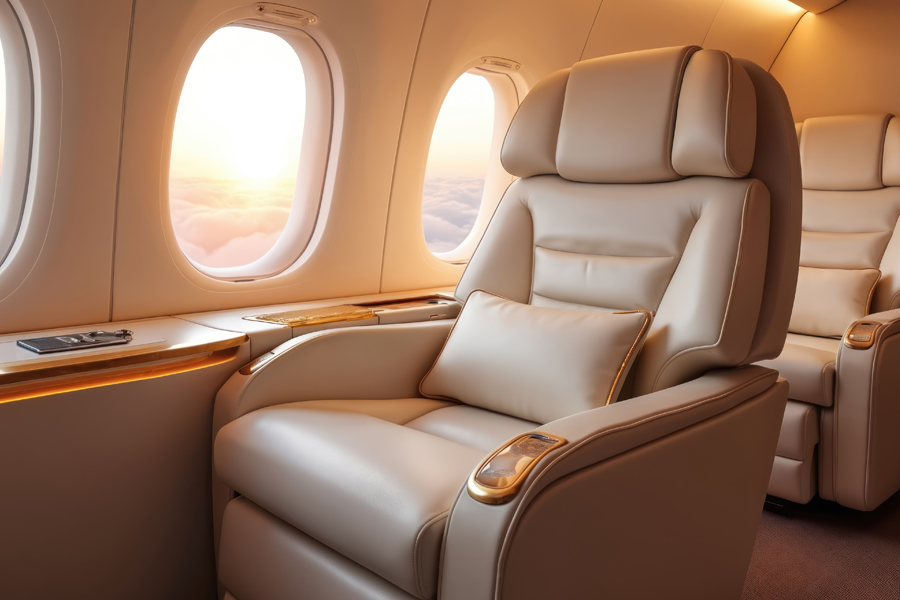
In private aviation, everyone understands luxury no matter what part of the business they come from. But as 2025 winds down, we start to think ahead and wonder how things might evolve over the next 5 years. As amazing as it is today, we know a new measure of luxury is evolving – one that goes beyond today’s definitions. In the near future we won’t just be able to fly somewhere faster; we’ll arrive healthier, calmer, and more focused than when you took off.
From AI managed personalization to cabin environments that respond to your physiology, the next generation of jets led by innovators like Bombardier and others, are redefining what the private jet lifestyle will feel like.
Ten years ago, luxury in private jets was measured in fine leathers, champagne bars, and cinematic entertainment. Today, the conversation has shifted to include biometric comforts. Things like cabin altitude (pressure), humidity, air purity, lighting, acoustics, and even scent.
Manufacturers are seeing a trend to wellness as a new criterion, high on the shopping lists of potential buyers. They aren’t just buying aircraft anymore, they’re buying the ability to protect their bodies and minds from the stress of frequent, long-distance travel. Here are some of the things more sophisticated clients will be shopping for:
Cabin Altitude: By keeping your biorhythm closer to the ground, aircraft like the Bombardier Global 8000 will maintain a cabin altitude of just 2,900 feet while you’re at 41,000 feet, dramatically minimizing fatigue and jet lag.
Air Purity: HEPA filtration, UV-C sterilization, and continuously refreshed airflow are now standard features, ensuring cleaner air than many first-class cabins.
Humidity and Lighting: Advancements in adjustable humidity controls and circadian lighting systems will help passengers synchronize their internal clocks and arrive more refreshed.
As one cabin designer put it recently, “For the customer, true luxury is feeling good at the end of a 14-hour flight.” Manufacturers who can deliver will reap the benefits.
What about AI?
As we’ve discussed in previous blogs, AI advancements are allowing a level of customization and personalization that the industry has never seen before. In the time it takes to write this blog, AI will advance yet again with new learning and eventually, new utility.
Suffice to say that by 2030 your AI aircraft assistant will simultaneously book your meetings and hotels while it syncs your calendar, makes restaurant reservations and prepares the aircraft environment for your arrival.
We’ll go out on a limb here and say we don’t think AI will also be flying the aircraft … yet.
What Passengers Will Expect by 2030
By the end of the decade, luxury travelers will they’ll expect their private jets to be adaptive, intelligent sanctuaries. Here’s what they may be thinking of:
Predictive Comfort: Jets that sense discomfort before you do – adjusting lighting, reclining seats, or changing cabin temperature automatically.
Seamless Transition: Integration between your home, car, and jet environments, so the moment you board, your surroundings feel familiar.
Wellness Metrics: Personalized dashboards showing hydration, rest, and stress levels during the flight to help travelers stay on track.
Silent Travel: Cabin acoustics engineered to near total quiet, so far a profound luxury that even money can’t buy commercially.
The Data, Privacy, and Personalization Paradox
All of this technology depends on the ability to access and share data. In the world of high-net-worth individuals, privacy is paramount, so that can present some barriers. Future jet systems will need to find the balance between personalization and discretion.
In the 2030s, private aviation will embrace balance along with luxury making health and wellness as important as performance and privacy.