
It’s a new year, and as usual we like to think about what’s ahead for our industry. The one thing we’re sure you know is that aviation technology isn’t just evolving, it’s accelerating as fast as those private jets can carry us! Today we’ll focus on three key topics: Predictive maintenance, ever smarter avionics and data driven flight dynamics.:
- Predictive Maintenance = In Service
Gone are the days when “scheduled maintenance” meant grounding an aircraft for days at a time only to discover a minor issue. Artificial Intelligence is now doing what seasoned engineers once relied on gut instinct for – predicting failures before they happen and scheduling maintenance just in case.
Modern business jets are equipped with advanced onboard aircraft health monitoring systems. These sensors collect thousands of data points per second, feeding AI algorithms that detect early signs of component fatigue, pressure anomalies, or fluid irregularities.
For pilots and maintenance crews, this means fewer unscheduled outages, more accurate part forecasting, and improved dispatch reliability. Operators using AI-based systems report up to a 25% reduction in maintenance downtime, according to recent industry data. “AI is becoming the partner of maintenance,” says one fleet manager. “It tells us what needs attention before we even land.”
- Smarter Avionics = Smarter Pilots
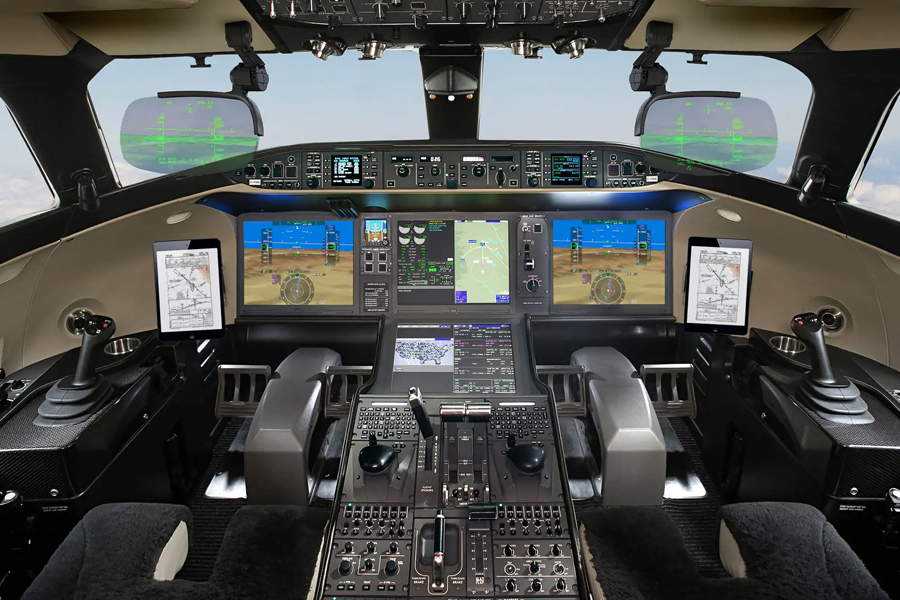
Cockpits are evolving from digital displays to intelligent decision environments. Avionics suites like the Garmin G5000, Collins Pro Line Fusion, and Dassault’s FalconEye are now integrating real-time weather AI, terrain scanning, and adaptive flight-path optimization that respond to changing conditions automatically.
These advances reduce workload, enhance safety, and help crews make faster, data-informed decisions. Synthetic vision systems (SVS) are especially valuable in challenging terrain and low visibility operations – a game changer for mountain airports like Aspen, Innsbruck, and Courchevel, where many private jets position in winter.
But this new technology also introduces the challenge of keeping pilots current. Training centers and OEMs are now building specialized AI and automation modules into type ratings and recurrent training, ensuring flight crews stay ahead of the systems designed to assist them.
- Data-Driven Flight Management = Unparalleled Efficiency
Unquestionably, the future of private aviation belongs to data literate flight teams – pilots, dispatchers, and engineers who understand how to interpret and act on AI insights.
The world’s top jet manufacturers are already building integrated dashboards that combine flight data, maintenance records, fuel metrics, and SAF reporting into a single interface. These tools don’t just support compliance; they help owners make smarter decisions about asset utilization and lifecycle cost control.
Looking forward as the private jet industry balances high technology paired with human expertise, we’ll be able to fly safer and smarter than ever before.