
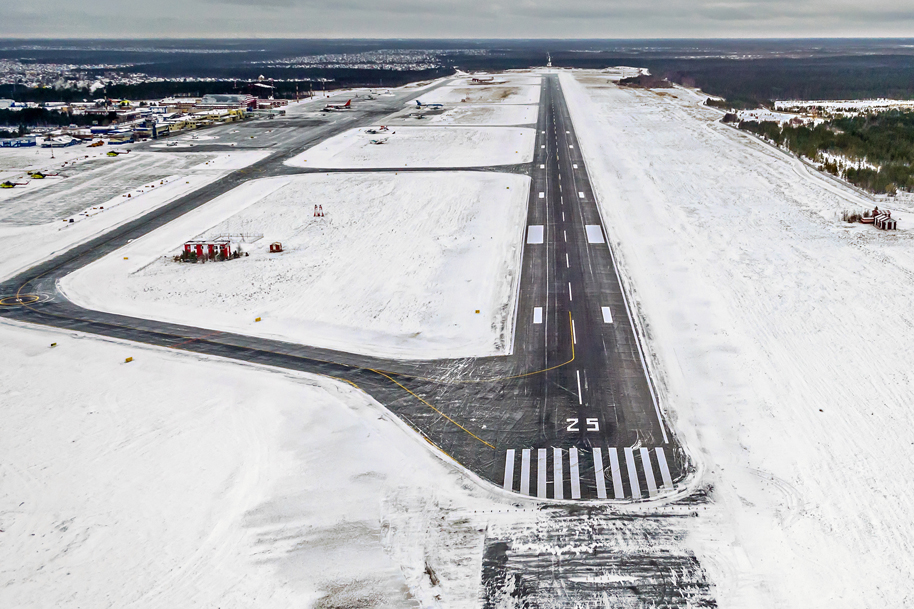
Many private jet travelers likely don’t realize that for pilots and flight crews, landing the aircraft is often one of the most demanding phases of any journey. And it can become even more complicated when runway conditions are sometimes less than ideal.
While the vast majority of landings are well executed and comfortable for passengers, things like rain, snow, slush, ice, standing water, and even excessive heat can dramatically affect how a private aircraft performs during takeoff and landing. Behind every smooth arrival is a series of detailed calculations, advanced aircraft systems, and critical pilot decisions designed to ensure safety under changing conditions.
Regardless of the destination or size of the airport, understanding runway conditions is essential to private jet operations. Let’s consider some of the conditions private operators plan for.
Why Runway Conditions Matter
Aircraft performance is heavily influenced by the interaction between the tires and the runway surface. On a dry runway, braking systems can operate at peak efficiency so pilots can rely on predictable stopping distances. But when water, snow, or ice enters the equation, performance margins can change very significantly.
Even a thin layer of moisture can reduce tire traction. Add freezing temperatures or slush, and stopping distances may become longer. It’s not uncommon for business jets to experience shorter runways at executive airports requiring pilots to apply knowledge and skill on every touchdown.
Every runway condition affects four key areas:
- Acceleration during takeoff
- Aircraft braking effectiveness
- Tire traction and directional control
- Required landing and stopping distance
Because of this, pilots never simply “estimate” runway performance. Every departure and landing involves performance calculations tailored to the exact conditions at that moment. Here are some of the things that must be measured:
Wet and Icy Runway Performance Calculations
Before takeoff or landing, pilots calculate how much runway length the aircraft requires under current conditions. These calculations consider:
- Runway length and slope
- Aircraft weight
- Outside temperature
- Wind direction and speed
- Elevation
- Runway condition (water, snow, slush, ice)
Fortunately, modern private jets use sophisticated onboard performance software to assist crews, but the responsibility still falls on pilots to interpret the data correctly.
A wet runway may increase landing distance requirements by 15% to 30% depending on aircraft type and conditions. An icy runway can increase stopping distances dramatically beyond that.
For example, a runway that appears merely “wet” may actually contain patches of standing water capable of causing hydroplaning where the tires ride on top of water instead of maintaining contact with the pavement. In these situations, braking effectiveness can drop sharply. Proper calculations and pilot skill make these challenges uneventful for passengers.
Winter operations add another layer of complexity as pilots must account for things like packed snow, black ice, slush drag, reduced visibility and crosswind challenges. Crews receive airport runway condition reports with real-time surface condition assessments before every arrival or departure.
Brake Systems and Anti-Skid Technology
Today’s private jets are equipped with highly advanced braking systems designed to maximize stopping power while preventing wheel lockup.
Anti-skid systems in aircraft work similarly to ABS brakes in your car, but on a much more sophisticated level. Sensors continuously monitor wheel rotation during braking. If a wheel begins to skid, brake pressure is automatically adjusted to restore traction.
This technology is especially valuable on contaminated runways where uneven traction may exist across different portions of the surface.
Many business jets also incorporate carbon brake systems, which provide stronger braking performance, better heat resistance, reduced aircraft weight and faster cooling times. They are particularly useful during repeated operations or high energy stops on shorter runways.
It’s important to remember that even the best brake systems cannot overcome physics. On severely contaminated runways, pilots may still choose to delay or divert a flight if they determine stopping margins are too narrow. That’s where knowledge and experience play a critical role in keeping passengers safe – even if they have to be inconvenienced for a time.
Thrust Reversers and Stopping Distance
Another major tool in runway safety is the thrust reverser system. After touchdown, many turbine powered private jets can redirect engine thrust forward to help slow the aircraft down. Rather than relying solely on wheel brakes, thrust reversers use engine power itself to reduce speed. You’ve likely experienced that upon landing in any private or commercial flights. That moment right after touchdown when you are pushed forward in your seat as you hear the roar of reverse thrust engine power.
There are a lot of benefits to thrust reversers as they reduce brake wear, improve stopping performance, provide better control on slippery runways and create stronger safety margins on short runways.
However, their effectiveness depends on runway conditions and aircraft speed. Reverse thrust becomes less effective at lower speeds, meaning wheel braking still plays a major role in bringing the aircraft to a complete stop. Pilots take many factors into account at the moment of touchdown – brake pressure, remaining runway, surface conditions and crosswinds are all in play at the same time. Here’s a bit more on their decision making processes.
Pilot Decision Making in Marginal Conditions
Technology plays a major role in modern aviation safety, but pilot judgment remains the most critical factor. Private jet crews constantly evaluate whether conditions remain within safe operating limits. Sometimes the safest decision is not to land at all.
Pilots also consider visibility, braking action reports from preceding aircraft landings, payload. In addition, before any landing they always know where their alternate airports are. For example, a runway may technically remain “open,” but deteriorating braking reports from preceding aircraft may lead a crew to divert elsewhere. This happens very quickly and pilots and crew are prepared to make decisions as required. This is a key reason why private aviation maintains such strong safety standards.
To enhance preparedness, business aviation crews undergo extensive recurrent simulator training that recreates things like hydroplaning, rejected takeoffs, crosswind landings, brake failures and all imaginable runway conditions.
The Role of Airport Infrastructure
Runway safety is not solely dependent on the aircraft itself – Airports play a critical role in maintaining usable runway conditions. They manage snow removal, ice treatment, rubber deposit removal (from tires), surface friction testing, and drainage using specialized equipment. Grooved runway surfaces also help channel water away from tires, reducing hydroplaning risk during heavy rain.
Crews make themselves familiar with every airport and it’s capabilities as runway maintenance can vary significantly at smaller regional airports frequently used in private aviation.
Final Thoughts
Runway conditions are one of the most important variables in private jet performance. While passengers may only notice rain on the cabin windows or snow beside the runway, pilots and crews are analyzing a complex set of operational factors behind the scenes.
From sophisticated anti-skid braking systems to thrust reversers and advanced performance calculations, modern private jets are engineered to operate safely in a wide range of environments. But technology alone is never enough. Skilled pilot judgment and conservative decision-making remain the foundation of safe operations.
The next time a private jet lands smoothly on a rain-soaked runway or departs confidently after a winter storm, there is an enormous amount of preparation, calculation, and expertise making that performance possible.
About Avionco
Formed in 2000 by Mike Dodd and Josh Dodd, Avionco is a premier aircraft services provider, purpose-built to serve aircraft owners whose business and lifestyle needs require impeccable service and efficiency in everything they do.
Josh Dodd, COO, leads day to day operations with a team of dedicated senior management professionals delivering a complete suite of flight management services including Pilot and Crew selection, In-Flight and Ground Operations, Safety and Compliance, and Entry Into Service (EIS). Learn more at www.avionco.com