
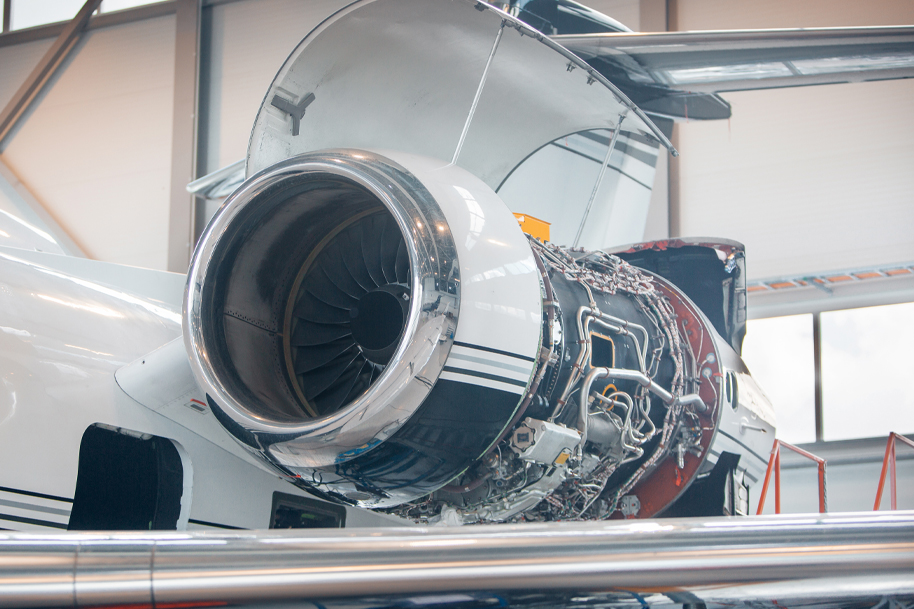
Decades ago, if you’d ever stood near an airport watching private jets take off, the noise level was far more intrusive than that of modern business jets today. Today’s engines are remarkably quieter, and even more impressive is that while producing less noise, they’re also far more powerful, more fuel-efficient, and significantly cleaner than previous generations.
Years of engineering advances have transformed the way business jet engines work.
In today’s blog, we’ll take a look at the engineering that has transformed engine design.
High Bypass Ratio
One of the biggest changes in jet engine design is something called the high bypass ratio. In a world where technology usually gets smaller, modern turbofan engines actually appear much larger than older engines. Much of that appearance comes from the enormous fan at the front of the engine.
Shouldn’t a larger fan make more noise, you say? Not really. Here’s why.
Only a portion of the air entering the engine passes through the combustion chamber where fuel is burned. The majority of the air flows around the engine’s core. Engineers call this the bypass airflow.
It gets down to math. The ratio between these two airflows (1. through the combustion chamber and 2. around the engine core) is known as the bypass ratio.
For comparison:
- An older engine may have had a bypass ratio of 2:1.
- Many modern commercial engines exceed 10:1.
- Business jet engines vary depending on aircraft size, but newer designs generally feature much higher bypass ratios than previous generations.
Moving a larger mass of air more slowly creates thrust far more efficiently than accelerating a smaller amount of air to extremely high speeds. The engine doesn’t have to work as hard.
The result?
- Less fuel burned
- Lower exhaust velocity
- Substantially reduced engine noise
- Improved overall performance
It’s a primary reason why modern aircraft are both quieter and cheaper to operate.
Other Advances in Noise Reduction
Bypass ratios aren’t the only advancement that has created quieter engines. Numerous technologies that are specifically designed to minimize noise work together to maximize the effect.
For example:
Acoustic Engine Liners
The inside of the engine nacelle (the outer housing surrounding the engine) contains carefully engineered acoustic materials that absorb sound waves before they escape into the surrounding air. They’re essentially sophisticated sound insulation designed for jet engines.
Fan Blade Design
Today’s fan blades are masterpieces of aerodynamic engineering.
Instead of simple straight blades, modern fans use swept back designs, composite materials, carefully optimized spacing, and computer designed airfoil shapes that reduce noise causing turbulence. Private jet passengers quickly notice the difference between this and the hum they are familiar with in commercial travel.
Serrated Engine Nozzles
Some newer engines feature distinctive zigzag or “chevron” edges around the exhaust nozzle. These serrations help the hot exhaust mix more gradually with the cooler outside air, reducing turbulence – the primary source of jet exhaust noise – further.
The result is a noticeably quieter departure without sacrificing performance.
The Sound of Efficiency
These technologies do much more than just reduce sound. They improve many aspects of flight for owners and operators. Even a modest improvement in engine efficiency can save operators hundreds of thousands – or even millions – of dollars over an aircraft’s lifetime. Today’s engine design allows aircraft to fly farther while burning less fuel than previous generations resulting in lower operating costs, greater payload flexibility and reduced maintenance needs over time.
Engine Performance Management
Business jet engines contain sophisticated electronic systems that continuously monitor temperature, pressures, fuel flow, vibration and rotor speeds.
A system known as Full Authority Digital Engine Control (FADEC) optimizes engine performance every second of every flight.
Instead of pilots manually adjusting engine settings, FADEC automatically calculates the ideal fuel flow and operating conditions providing fuel efficiency, reliability, lower pilot workload, and reduced wear on engine components.
Quiet Goes Beyond Comfort
It’s easy to understand how lower engine noise benefits passengers, but it goes beyond that. Communities surrounding airports also benefit from quieter aircraft, making it easier for airports to coexist with nearby neighborhoods. Due to strict noise restrictions at some locations quieter aircraft often enjoy greater access to more airports, fewer operating restrictions, and extended operating hours.
The future of private aviation looks bright…but sounds quiet.
About Avionco
Formed in 2000 by Mike Dodd and Josh Dodd in Calgary, Avionco is a premier aircraft services provider, purpose-built to serve aircraft owners whose business and lifestyle needs require impeccable service and efficiency in everything they do.
Josh Dodd, COO, leads day to day operations with a team of dedicated senior management professionals delivering a complete suite of flight management services including Pilot and Crew selection, In-Flight and Ground Operations, Safety and Compliance, and Entry Into Service (EIS). Learn more at www.avionco.com