
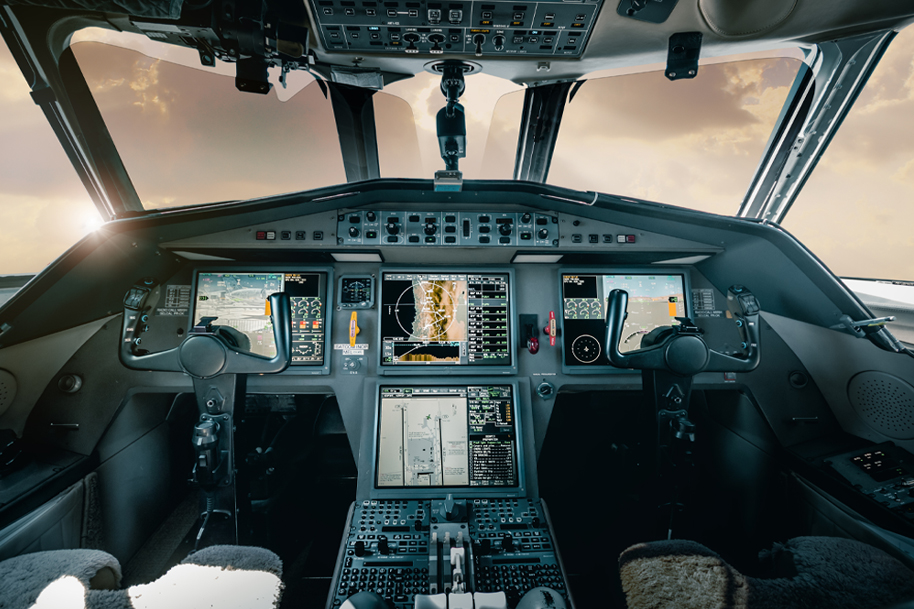
“Autopilot” is one of the most misunderstood terms in aviation.
Today, we asked Josh Dodd, COO and leader of the Avionco Leadership Team to help us understand the ins and outs of how autopilot is used in today’s modern private aircraft. Here’s what we learned.
Many people assume autopilot is simply a switch the pilot flips to maintain control of the aircraft at a specific heading and altitude. In reality, autopilot is a complex, highly sophisticated tool that can do a variety of things based on pilot oversight and input.
Autopilot isn’t just a single function. It’s a actually a collection of various modes that control different aspects of flight, including:
- Heading mode – maintains a selected direction
- Altitude hold – keeps the aircraft at a set altitude
- Vertical speed mode – controls climb or descent rate
- Navigation mode (LNAV) – follows a programmed route
- Vertical navigation (VNAV) – manages climbs and descents based on the flight plan
Pilots select and manage these modes depending on the phase of flight they are in.
How Autopilot is Used During a Typical Flight
Autopilot is typically engaged shortly after takeoff, once the aircraft is stable and climbing. From there, it can do a variety of things:
- Maintain climb profiles
- Follow complex routes across continents
- Adjust altitude for fuel efficiency
- Execute precise descent paths into busy airspace
However, it isn’t a system that’s left alone. Pilots are constantly monitoring and adjusting it. Autopilot only does exactly what it’s told – nothing more, nothing less.
Despite its capabilities, autopilot does not make independent decisions, replace pilot judgment, or handle unexpected situations on its own. That’s why on every flight pilots remain engaged and ready to change modes, override inputs or disconnect the system when appropriate.
Autopilot is integrated with the Flight Management System (FMS), which stores the flight plan. The FMS provides waypoints and routing, speed and altitude targets, and performance calculations. It then uses this data to guide the aircraft along the planned route with remarkable precision.
Safety Through Precision and Reduced Workload
One of the most critical pilot skills is understanding exactly what the autopilot is doing at any given moment. In doing so, the system significantly reduces pilot workload, especially during long flights or in complex airspace, allowing pilots to focus on monitoring systems, communicating with air traffic control, and managing changing conditions.
In the end, Autopilot should be best understood as a partnership. The system provides accuracy and consistency. The pilot provides judgment, adaptability, and decision-making. Together, they create a level of safety and efficiency that neither could achieve alone.
This is how it works today of course. Tomorrow will evolve quickly with the advent of artificial intelligence, however. Read some of our past blogs on AI to see some of the implications. We’ll be building on that more as things evolve.
If you have private jet service or regulatory needs, contact us at www.avionco.com and we’ll be pleased to help.
About Avionco
Formed in 2000 by Mike Dodd and Josh Dodd, Avionco is a premier aircraft services provider, purpose-built to serve aircraft owners whose business and lifestyle needs require impeccable service and efficiency in everything they do.
Josh Dodd, COO, leads day to day operations with a team of dedicated senior management professionals delivering a complete suite of flight management services including Pilot and Crew selection, In-Flight and Ground Operations, Safety and Compliance, and Entry Into Service (EIS). Learn more at www.avionco.com